
Blog
How to Plan Your Vehicle Export Timeline Around Current UAE Shipping Conditions

For over two decades, Dubai has been one of the world’s most trusted hubs for new-vehicle export. That reputation isn’t an accident, it’s built on disciplined timeline planning, and in 2026, that discipline matters more than ever.
Ocean freight has entered what industry analysts call a “new normal,” where variability is the baseline condition rather than the exception.
For export dealers, moving vehicles from the UAE to Africa, Asia, and Latin America, this shift doesn’t have to mean lost deals or frustrated buyers.
It means the timeline itself has become a strategic asset, and the dealers who plan it well are winning repeat business.
The Market Has Changed, And That’s Not Necessarily Bad News
Maritime disruption is no longer a one-off shock; it’s an operating condition, with vessels taking longer alternative sea passages and carriers adjusting routing on a rolling basis.
Schedule reliability has dipped on several major lanes, alongside tighter capacity and longer working-capital cycles for shippers.
But there’s real reason for optimism too. Vessel traffic through key export corridors has rebounded meaningfully, and carriers are reinvesting in capacity scaled back in recent years.
Capacity is coming back, it’s simply arriving on a different schedule. The takeaway: this is a market to plan around, not panic about.
Build Buffer Time Into Every Quote
The single biggest adjustment dealers should make in 2026 is treating transit-time buffers as standard practice, not an exception. Where a shipment once had a predictable window, current conditions call for a wider planning range, typically one to two additional weeks beyond the historical average, depending on destination port and vessel availability.
This isn’t just defensive. Car Dealers in Dubai who quote realistic, buffered timelines up front consistently report fewer disputes and stronger long-term relationships than those who promise pre-disruption speeds and then have to explain delays.
A transparent buffer, clearly communicated at the point of sale, protects your credibility far more than an optimistic date that slips.
Lock In Documentation Early
Freight capacity is only half the equation, paperwork readiness is the other half. With berth windows less predictable, vehicles that are documentation-complete (export certificate, bill of lading, insurance, destination-country compliance paperwork) move to the front of the queue when space opens up. Vehicles that aren’t ready lose their slot.
For dealers managing bulk orders, this means shifting documentation work earlier ideally in parallel with sourcing, not after it.
Reconsider How You Think About Insurance
Marine cargo insurance premiums have moved with the broader freight market, and elevated premiums are likely to persist. Build current rates into your landed-cost calculations, and revisit them quarterly rather than annually.
It’s also worth confirming exactly what your export partner’s coverage includes during transit, especially for high-value SUVs, pickups, and specialty vehicles.
Diversify Your Shipping Windows, Not Just Your Routes
Relying on a single sailing date or carrier narrows your options exactly when flexibility matters most. Spreading bulk orders across multiple sailing windows, even by a week or two, reduces the risk that one schedule change disrupts an entire shipment.
For orders of ten-plus units, splitting across two or three sailings can mean the difference between on-time delivery and a total delay.
Lean on Sourcing Hubs With Deep Logistics Experience
Not every exporter has the same depth of relationships with carriers and freight forwarders. Dealers who source through partners with decades of shipping relationships, rather than one-off freight bookings, tend to get earlier visibility into available capacity, more consistent RoRo vessel allocations, and faster resolution when a schedule shifts.
At Al Karama Motors, we treat logistics as part of the product, not an afterthought. With over 22 years of export experience from the UAE, our team maintains ongoing relationships with shipping lines and freight partners so our dealer and broker network isn’t guessing about capacity, they’re getting real information, early.
The Bigger Picture
None of this changes the fundamental appeal of sourcing vehicles from the UAE. Dubai’s position as a global re-export hub, its GCC-spec inventory, and its established trade infrastructure remain significant advantages. What has changed is the need for more deliberate timeline management, and that’s a skill, not a setback.
As capacity gradually normalizes and carriers restore fuller service, the exporters who built resilient processes during this more variable period will be best positioned to scale quickly. Realistic planning today is what protects, and grows, your business tomorrow.
Ready to plan your next export order? Contact Al Karama Motors for current shipping timelines and GCC-spec vehicle availability.
Al Karama Motors FZE has exported brand-new vehicles from Dubai for over 22 years, working with dealers, brokers, fleet buyers, and government organizations worldwide.
Looking for a specific vehicle?
Tell our Dubai team the model, quantity and destination. We will help you check availability and export options.
Related Automotive Guides
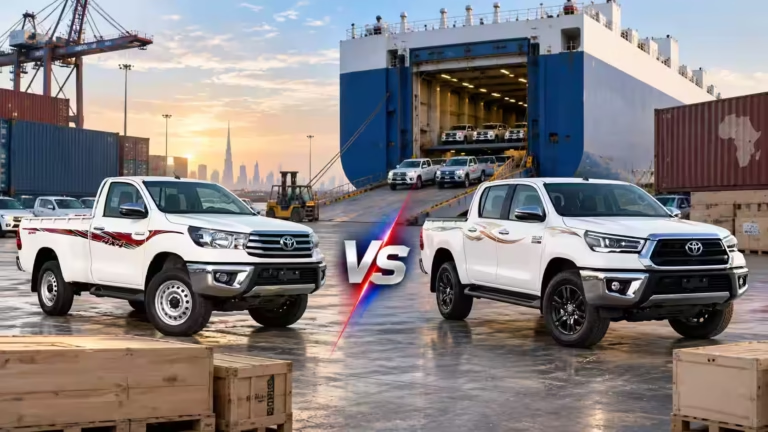
Toyota Hilux Petrol vs Diesel for LHD African Markets: Which One Fits Your Use Case?
Have you ever asked whether petrol or diesel is the better Toyota Hilux for Africa and received a one-word answer? That answer is usually…
Read article
How to Buy a Car in Dubai for Export to LHD African Countries
Dubai has quietly become the easiest place in the world to buy a brand-new car and ship it home. If you're a dealer, broker, or buyer sourcing left-hand-drive…
Read article
Toyota Hybrid SUVs in UAE: The Fuel-Saving Choice Every Smart Buyer Is Making Right Now
Toyota Hybrid SUV Cars in UAE | Export-Ready from Dubai Fuel costs matter for buyers managing vehicles across Africa, Asia and the GCC. Toyota…
Read article